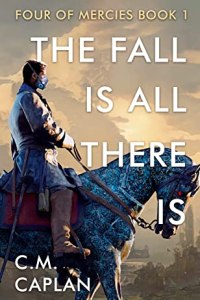
This is an essay by C.M. Caplan on their writing journey that lead to his SPFBO 9 contender novel The Fall Is All There Is.

CW: Brief cursing.
A few years ago, someone left a review on my first book, The Sword in the Street that began with “sometimes you’ve got to take a gamble as an author and go all in.” It was a lovely review, centered around how truly personal the book felt. From the relationship between the main characters, to the autism rep, to the degree to which I focused on their interior lives, and everything that they had going on in their heads.
The thing that sticks with me about that review, years later, is the fact that even while I was writing it I never thought of these things as a gamble. As going all in.
When I first started The Sword in the Street, there was no guarantee I would even make it to the end of the first draft. I’d spent eight years failing to finish anything. So I knew I needed to try something new.
“I was so terrified that people wouldn’t like what I wrote, so I didn’t want to stray too far out of what was expected of me.”
A little while ago, I tried to piece together what made that book so different. Why I was able to finish that one but not any of the other abandoned, half-formed projects I’d left collecting file space, scattered across long-neglected folders languishing in Google Docs or Onedrive. One thing I noticed, the constant strain of tension shot through everything I wrote before my debut that set it apart from everything that came next, was a struggle between what I wanted to do, and what I worried other people would think of me, if I did that.
I was honestly astonished. In a lot of these previous manuscripts, I’d thought that imposing limitations on myself or the book would make the book better. Not that there’s something inherently wrong with limitations—some of the best art is made on a budget. But some of these constraints were ones I’d fashioned for myself purely because I thought that I was supposed to. I was so terrified that people wouldn’t like what I wrote, so I didn’t want to stray too far out of what was expected of me, as a fantasy writer.
Just to be sure.
Just to be safe.
For example, I’d never found hard magic systems particularly compelling. But since I wanted to be a fantasy writer, I’d find ways to shoehorn it in. Then I’d decide I didn’t like it all that much, and I’d quit.
“I wanted to write a story other people liked. Which was often in conflict with what I wanted to do.”
Hell, before I wrote Sword in the Street I never gave a character any weapon other than a longsword!! Because after all, I’d wanted to write something based on the Medieval era. So it would help to be historically accurate, right? It didn’t even occur to me back then that that wasn’t even historical accuracy. It was just what I saw everyone else doing.
I was so caught up in imposing these limitations on myself that I treated it as an inherent virtue. I figured that by placing them there that would make whoever read it like the story more, even if it wasn’t what I wanted to do. I wanted to write a story other people liked. Which was often in conflict with what I wanted to do.
This all culminated in a book I was sure would be my debut. It had everything I loved in it—or at least, the things I thought would make other people love me. It was part of my college thesis for my BA in creative writing. it was going well, people around me had received it well. I’d even won an award for it before it even reached a final draft! But ultimately it crashed and burned after eight months, and I lost the enthusiasm to ever pick it up again before I finished a first draft.
I was devastated. This book that had won me an award! An award that paid money! And I couldn’t even finish it? What was wrong with me? I was having serious doubts about whether or not I was cut out for this.
So I started getting more intentional with my choices. And looking back, I realize—that’s what I was missing. Intention.
“Failing at something so completely really forces you to reevaluate absolutely everything about your approach.”
That failed book was doomed from the start. Because I was limiting myself to what I figured other people would enjoy. I was putting my own blinders on, handicapping my ability to even try something different.
I’ll tell you what, though. Failing at something so completely really forces you to reevaluate absolutely everything about your approach.
I went back to that book, and I tore it apart. Puzzled out what worked and what didn’t. Because there were aspects of that failed book that I did love. And I wanted to figure out why I loved it, why I put it there, and most importantly—did it have any reason to exist in this book?
Then I went back to my favorite books. Took stock of what I loved. Took notes. And I started thinking about how writers use the tools in their arsenal. Things like tropes, genres, characters, ideas, worldbuilding—these were resources, and my favorite authors were always engaging very intentionally with those resources. And one thing I’d gotten down to a science during my time in college was the ability to closely read and explicate texts. So I did exactly that.
“I wanted to make decisions because I liked them and I hoped somebody else will, not out of fear that somebody else wouldn’t.”
Intention, then, seemed like the most important tool to utilize. Better than any limitations I was placing on myself for word count, form, content, or any genre specifications. This is not to say that there were no rules. But I wanted to live in The Hope™ and not The Fear™. I wanted to make decisions because I liked them and I hoped somebody else will, not out of fear that somebody else wouldn’t. So I wrote the first draft of Sword in the Street 14 nonconsecutive days, through October of 2019, so that I would not have time to wonder what people would think.
Going into Sword in the Street, I knew I was in the middle of a bit of a creative drought. I knew I needed a very small focus instead of trying to go big but generic like I had with the book I failed to write, because I’d written it for other people, not me. A snail’s-eye-view kind of thing. I wanted to get good at really homing in on a handful of ideas, so that
I could take what I learned and put it to a better use later. Sword in the Street was me placing my own limits on myself with intention. On purpose, and without consideration for what other people would think.
There are no longswords in that book. And there is very little magic. You could even argue none. And that was a very intentional choice. I wanted to break away from everything I had tried to be before, and I wanted to do it on purpose.
But in the background, something was building. Ideas were coming back to me, and I needed Sword in the Street to be a lightning rod that could teach me how to write with intention. Because on some level I knew that drought was coming to an end—and when it did, I wanted to learn what I had utilized to tackle something bigger. To zero in the way I’d taught myself to do, and this time, to make it huge.
“By setting myself against my previous conception of the genre, I was still ruled by those limitations.”
Because I’d made a few mistakes putting Sword in the Street together. By making it into the antithesis of all the arbitrary rules of what I thought the genre could be, it became its own kind of limitation. By setting myself against my previous conception of the genre, I was still ruled by those limitations—if only because I was so focused on inverting them. I was still not doing my own thing, I was just subverting the style of storytelling that had been keeping me chained down for the years before my debut. It was a decent trick for my first book, but I doubted it would continue to work, every time.
The next book needed to be bigger. And it needed to be completely unchained from any previous concepts of what genre fiction had to be. I’d gotten a few ideas while working on Sword in the Street—the idea of a royal family took a lot of inspiration from Robin Hobb’s work, but I wanted to put my own flair on it, since I felt like many stories about royals and succession lacked the palpable sibling rivalries and family dramas any story about royals would have. So I took more inspiration from The Lion In Winter (from with Fall gets its title), one of my favorite works of art to ever exist, since it was the only one that captured the concept of absolute power mixed with family drama with an ethos I felt I could hone in on for my own purposes.
“I had ideas about toxic air and gas masks, and a fusion of science and magic.”
I knew I wanted to do first person, since that was always my preferred style, a deeply interior delve into one mind. And I’d had Petre riding in the backseat of my mind since around 2013, a character who had followed me out of a suburban fantasy I’d written when I was seventeen, and snuck his way into a number of abandoned projects over the years. I knew from the start his voice was more conversational and modern, which had been the death knell for a number of projects before, as I wasn’t a fan of urban fantasy, and I could never bridge his way of speaking with a more Medieval-themed conception of what I thought fantasy ought to be.
So I decided it needed to be science fantasy. I had ideas about toxic air and gas masks, and a fusion of science and magic. A distinct image of someone running through a hall against a backdrop of gigantic windows that glowed orange and sang like a Latin chorus when the wind swelled.
I’d realized the stereotypical version of ghosts I’d seen in media revolved around creatures that looked to float around in a gaseous state, so I wondered what would happen if you breathed them in? I was immediately struck by the idea of someone inhaling a ghost who had frozen to death, who now constantly bundled up in layer upon layer, still shivering.
I knew I wanted guns, and a sort of flintlock fantasy flair, but I needed to give it a sci-fi spin, so I made caterwaulers, which need to be recharged every few shots, or fewer depending on if you’ve set the dial to stun or kill.
“I at first made the narrator a bastard, until I realized nobody else had a claim on being a fucking quadruplet in real life.”
And I knew they had to be quadruplets. Not right away—I at first stole directly from Hobb, and made the narrator a bastard, until I realized nobody else had a claim on being a fucking quadruplet in real life, which meant I had to stake mine, right? Of course I did.
Even when I started the book, I knew I had something insane on my hands. Something I’d never done before and was simultaneously horrified and obsessed with. But I’d never before felt so compelled to write something anyway.
The result was The Fall Is All There Is, and it is by far the best thing I’ve written. It’s a post-apocalyptic science fantasy epic with a smartass first person narrator, and the most fun I’ve had writing anything in about a decade. It retained a science-fantasy spin on a world that had suffered through a number of catastrophes, weird artifacts, though none of the wetware technology.
And while The Fall Is All There Is became something wildly different from the doomed project, it is also the most personal thing I’ve ever written. While much wider in scope than my debut, it also served as a deep dive into my conception of an autistic mind in a way I’d never done before. And I had always wanted to write a family drama, since I know no one else who can testify what it’s like to be a quadruplet.
“Learning that I didn’t have to impose limits on myself, has got to be one of my biggest takeaways from the last few years.”
Weirdly enough, a lot of the stuff people really think is weird or different about the book came organically—and most of them only got incorporated in the final draft before proofreading, out of a desire to use lightsabers, but the only way I could think to make them different from the Star Wars variety was to give them a scientific spin. I let that inform the rest of the worldbuilding, and things got much weirder from there.
Learning that I didn’t have to impose limits on myself, at least not arbitrary ones—just as long as I was still proceeding with intention—has got to be one of my biggest takeaways from the last few years.
And you know what? It’s paid off. I spent so, so much time worrying if other people wouldn’t like my ideas, my book, my story. But it’s been seven months since then, and the majority of reviews say something along the lines of “I’ve never read anything like this before. Holy shit it’s one of the most original rollercoasters of a book, it’s like a heart attack how did he even put this together?” And honestly, it’s just floored me. I never even thought people would be anywhere near this thrilled to read a book that came so wholly from the depths of my demented psyche. But to all of you who have read this book and spread the word about it, I cannot thank you enough. You’ve all been wonderful, and I cannot wait to deliver you all the next one.
If you want to read C.M. Caplan’s praised and wild books The Sword in the Street and The Fall Is All There Is, clicking the images below will take you to their respective Amazon pages.

About C.M. Caplan
C.M. Caplan is the author of the SPFBO7 semi-finalist The Sword in the Street, and the post-apocalyptic science-fantasy The Fall Is All There Is. He’s a quadruplet (yes, really), autistic, and has a degree in creative writing. He was awarded his university’s highest honor in the arts for his work. His short fiction also won an Honorable Mention in the 2019 Writers of the Future Contest. If you enjoy his books, you can rate them on Goodreads and Amazon.


 Tiny Elf Arcanist
Leave a reply to Balance Thy Life Cancel reply