It’s time to meet the final guest of my TEA Party. Author Al Hess reminisces on the representation he had growing up and celebrates how it has evolved.
Recently, I’ve been binge watching the early seasons of Law & Order: Special Victims Unit. They were filmed in the late 90s and are very much a product of their time, but I was still taken aback by the way trans characters were treated and spoken about. Their only roles were as sex workers, and Benson and Stabler casually tossed around slurs no respectable person would use today.
Were there any Law and Order episodes where trans people were treated with dignity and understanding? I turned to the internet to find out and was pleasantly surprised to discover that the newer seasons have good trans rep, the characters don’t end up as corpses, and they’re played by actual trans actors.
Watching early episodes, then switching to new ones, gave me severe cultural whiplash. And it made me think about the deficit of queer media during my teen years in the 90s compared to the abundance of books and TV out there now.
I have always loved reading. But when I was younger, I didn’t know what I liked to read. I’d been gifted fantasy classics like The Chronicles of Narnia and The Hobbit, and I distinctly remember my mom giving me a copy of Split Infinity by Piers Anthony. Though I enjoyed that book, fantasy wasn’t my favorite.
We read plenty of lit fic in school, analyzing the prose and finding deep metaphors where there were none. It was interesting, but it wasn’t a genre I would seek outside of the classroom.
“I would invariably pick up Stephen King or Michael Crichton simply because I was familiar with them.”
I loved science fiction, but I had trouble finding things in the genre that suited me. It was either too technical, too horrific, or too dense. I’d wander past the high bookstore shelves in Borders, running my fingers along the spines of the sci-fi books and hoping a cover or blurb would catch my interest. But I was both overwhelmed and underwhelmed by the choices. I could have spent hours blindly flipping through the paperbacks, but all of them felt the same. I would invariably pick up Stephen King or Michael Crichton simply because I was familiar with them.
I read the book Sphere four times. My paperback is battered and creased and still has a place on my shelf. Likewise, I have the entire Dark Tower Series in first edition hardbacks. But I doubt I’ll ever reach for these books again. I’m simply tired of reading stuff by old straight white guys when there are so many other stories available.
I can walk into a bookstore now (sadly not Borders), and head right for the LGBTQ+ section. I can open Goodreads and find lists curated by any theme imaginable, or simply type a niche genre of book into a search bar.
You want Latine trans man romance? It’s out there. You want post-apocalyptic books written by Indigenous Americans? You can find them too. Hell, if you want bisexual sentient breakfast cereal, Chuck Tingle has got you covered.
I didn’t have the books I needed back when I was a teen. But I also didn’t know what I needed because I never saw it represented anywhere. Being autistic, I tried my best to fit in and embody the person people expected me to be. (Which didn’t work. Not only was I considered weird, peoples’ gaydars constantly went off around me, and they thought I was a lesbian.)
“Met with the response ‘You’re just a tomboy,’ I had no rebuttal. I knew that was wrong, but I didn’t have the vocabulary to articulate why.”
If I’d stumbled upon gay relationships or trans characters in the books I’d read, I would have been able to figure myself out a lot sooner. Several times, I was so close to realizing I was trans. But met with the response “You’re just a tomboy,” I had no rebuttal. I knew that was wrong, but I didn’t have the vocabulary to articulate why.
What a world we live in now, where people in any stage of figuring themselves out can reach for something by Aiden Thomas, Charlie Jane Anders, TJ Klune — or Al Hess — and find a character who becomes a mirror to their innermost feelings.
It’s easy to get bogged down in all of the hate and anti-trans legislation that conservatives are pushing for their fear-mongering campaigns. It’s easy to be disheartened by once-supportive companies caving to the threats of bigots. But loud doesn’t mean correct, and it doesn’t mean majority.
We’re surrounded by narratives of queer and trans joy: Marceline and Princess Bubblegum kissing on screen; Brotherhood of Steel’s aspirant Dane using they/them pronouns; publishers like Angry Robot championing and uplifting queer stories. And, yes, new seasons of Law and Order where Olivia Benson doesn’t bat an eye at a soldier mentioning he’s a trans man. Now if they could just do something about the writing.
Check out some of Al’s Books
Mazarin Blues

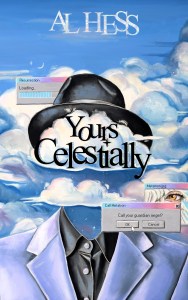
Yours Celestially
World Running Down

About Al Hess
Al Hess is author of World Running Down, Key Lime Sky, Yours Celestially, and the award-winning Hep Cats of Boise series.
When not hunched before a computer screen, Al can be found at his art desk. He does portraits in both pencil and oil paint, and loves drawing fellow authors’ characters nearly as much as his own. He writes cozy and uplifting stories with queer, trans, and neurodiverse representation.
Al is represented by agent Ren Balcombe at Janklow & Nesbit.

 Tiny Elf Arcanist
Leave a comment