My Tiny Elf Arcanist Party is almost over. Our last guest, Laurie Janey, talks about a subject that strongly resonates with me: Self-doubt. The author of SPFBO 9 entry The Crossing shares her experience writing her debut novel and brings the cake (metaphors).

I’ve decided to use this precious opportunity to talk about self-doubt in relation to the writing of my book, The Crossing, not because my thoughts on this topic hold any particular weight—I’m not a mental health professional—but because every now and then I read something honest and a bit vulnerable that I relate to and it makes me feel less alone, and perhaps if I’m candid about my experience, I can provide that feeling for somebody else.
With that long sentence out of the way, I’ll get straight to the point: It took me more than ten years to write and publish this novel, and that’s not because it’s the greatest or most meticulously crafted piece of literature.
Over the course of that decade, self-doubt shaped and directed my life. It made me falter in my creativity, miss opportunities, shy away from making connections, and take every rejection as evidence that I wasn’t good enough, both in my creative work and my career. I wanted to be part of the book world, but I struggled to find publishing jobs, and felt like a hopeless, awkward outsider every time I got a foot in the door. My confidence disintegrated and my writing slowed down with it. I grew anxious and depressed. I spent years with my face pressed up against metaphorical windows, watching people work, create, and connect on the other side while I stood out in the cold, chastising myself.
“By most metrics, ‘failure’ seems like a fair description of my writing career.”
The first draft of The Crossing was written when I was a student, and instead of finishing the book and moving on to other things, I started it over and over again, scrapping tens of thousands of words each time. I switched it from first person to third person, from present tense to past tense. I rewrote it with one of the side characters as the protagonist. (In retrospect, it’s no surprise that awkward, ambitious, uncomfortable-in-his-skin Berro ended up being the character I focussed on.) I gave up on the book altogether for years, allowing it to follow me around like a dark cloud. I couldn’t fully commit myself to any other big projects, guilty that I’d already sunk a lot of time into this one, frustrated that it wasn’t ‘good enough’. I became irrationally convinced that if I didn’t finish it, I’d never finish anything, even though by then it was rooted in a much younger version of myself and was no longer the book I wanted to write. Eventually, I realised I had to publish it to stop myself working on it, and I wanted to do it some justice in honour of all the time I’d already spent. The process of getting it beta read, edited, proofread, typeset etc took a few more years, but finally, in December 2022, more than a decade after that first draft, I was able to push the button and let it go.
By most metrics, ‘failure’ seems like a fair description of my writing career. I haven’t done any real marketing, my book hasn’t sold many copies, and I do have days where I’m down on myself. I’m a human being, after all. However, something undoubtedly shifted when I self-published, and shifted again when I entered the novel into SPFBO9 and found a bit of community amongst fellow indie hopefuls. It doesn’t feel like failure to have overcome that massive hurdle of self-doubt, to have put myself out there to take whatever criticism, praise or indifference comes my way. Whether or not the book is representative of the sort of writer I am or want to be, I can’t pretend I’m not a writer anymore. I did the thing. I gave the book a chance, and a few people have even read it, and said they enjoyed it. That’s pretty amazing. Most importantly, I can now see the way ahead to future creative projects.
“If you want to write a book, write it and finish it.”
If there’s any lesson here, I’d say decisiveness is valuable when it comes to big goals with deadlines you’re setting for yourself. If you want to write a book, write it and finish it. If it takes ten years and you’re happy with that process, great! But if it’s taking ten years because you’re constantly doubting yourself, and it’s starting to mess with your mental health, then maybe you need to commit to another plan. Power through to the end whatever the outcome, or shelve it decisively and start something else, or scrap it entirely if that feels right. Just try not to linger in frozen uncertainty for too long, because your pet project might become a creative blockage, and instead of something that grows your confidence and ability, it could trip you up or drag you down into the depths of self-doubt.
There was a cartoon doing the rounds a while back that had a great impression on me—a baker (‘the artist’) unhappily comparing their cake creation to a bigger, more impressive-looking cake. A cake eater (‘the audience’) arrives and says excitedly, “Holy shit! Two cakes!” I wish I’d taken that to heart earlier in my writing life. I wish I’d baked that cake and presented it to the world much sooner, regardless of how it compared to other cakes. Even if nobody ate it back then, it would’ve cleared my kitchen for more cake creations, and I think that would’ve been creatively beneficial for me. Still—better late than never!
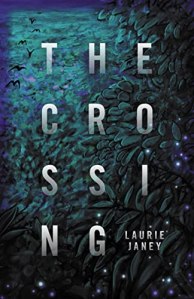
The Crossing is a science-fantasy (or soft sci-fi with fantasy frosting). It has an ensemble cast of student-aged characters, cosy vibes with streaks of darkness, lots of trees, tea, crystals and emotions. Perhaps that’s someone’s preferred type of book cake. I think I’ve stretched this metaphor far enough. Thanks for reading!
I can’t describe The Crossing better than the author without having read it myself, so here’s the book that took more than a decade in the baking.
About Laurie Janey
Laurie Janey is a writer, proofreader and very casual illustrator. She has an MA in Creative Writing from the University of Cape Town, and lives in London with her partner and their rowdy toddler.
 Tiny Elf Arcanist
Leave a comment