
James Lloyd Dulin’s debut No Heart for a Thief features POVs from two different teenage characters. Today, he tells us what is important to consider when writing young characters.

The Conflict Between Two Perspectives
Children are tricky to write mainly because readers have various experiences and understandings of childhood that they project onto young characters. Regardless of what an author writes, some readers are going to see young characters as too adult or too child-like for their age.
In a goldilocks quest for the perfect balance, what can authors do?
In my not-so-expert opinion, writing a young character with fully-realized personhood comes down to two conflicting perspectives.
Disclaimer: This is a blog post addressing generalities. We all will know children or young characters who don’t fit into this mold. However, in general, this is how I understand writing young characters.
Time for an analogy!
Have you ever spoken to a young child and laughed at something they said, only to be met with a serious look in rebuke? They said something that from your frame of reference was ridiculous or cute because you have a different understanding of how things work. However, from their end of the conversation, they had been completely serious.
This brings me to the first perspective.
Children believe their point of view (POV)
People, for the most part, think they understand how the world functions, and they believe their perceptions to be true. It takes wisdom to understand that our experiences and ideas are not universal. Many people don’t have that wisdom, especially younger people.
Young characters feel too self-aware and adult when they lack an inflated belief in their own POV.
Depending on their age, their brains haven’t developed to fully understand the messiness of human experience. Life is not black and white. Some things that seem like contradictions aren’t. Truth is sometimes relative.
“Adults think children don’t understand the world, and they treat them in accordance.”
People have many frameworks through which they see the world, so what is true for one person might not be true for another.
The younger a character is, the less they understand about the complexities and nuances of other people’s perspectives.
In shorter terms, they think they understand the world, and it is clear to them how things work.
This might show up with them making declarative statements without having justification. They may assume others will feel the same way they do. They might be very judgmental according to their personal guiding principles.
I know what you are thinking, “I know people who act like that, and they left childhood a long time ago.” You’re right. We are speaking in terms of maturity more than age. So, keep that in mind when thinking about how to characterize the children in your stories.
Now, onto the second perspective.
Adults think children are naïve
Many of us have heard the phrase, when you are older, you’ll understand. It’s because, on the whole, adults think children don’t understand the world, and they treat them in accordance.
One of the best ways to show characterization is by showing how people react to your characters. If someone is scary, they don’t announce they’re scary. Other characters react to them as if they are scary.
“When we look back on our younger selves, we know we didn’t understand life as well as we do now.”
If you want to write a young character, other people need to treat them as if they are young. For some people, this means they’ll dismiss a younger character’s ideas. For others, they’ll be over-protective.
Life teaches us all a lot of shit when we are growing up, and when we look back on our younger selves, we know we didn’t understand life as well as we do now. Our younger selves were more naïve, less worldly, less skilled. So, we assume the same of children.
We forget that from their perspective they understand it all, because we know at that age we didn’t.
This creates important tension between these two perspectives. Children think they understand the world. Adults think they don’t. Sometimes they have a better understanding than is assumed. Other times, they are even more ignorant than people thought. Either way, this tension and how children react to it is important for making a young character feel real.
Important note
The gap between a child’s understanding of the world and their perception of their understanding often shows their maturity. Less mature children will overestimate how much they understand by a greater degree, whereas more mature children will have a more accurate self-assessment or even underestimate their understanding.
“They might make rash decisions, make declarations they can’t uphold, or overestimate how universal their experience is.”
Their maturity is often linked to their age, but life-experiences affect it. Exposure to the world, travel, schooling, trauma, responsibilities, and a litany of other things could make a child mature faster or slower than one might expect.
If you are writing a young character who had to become an adult early in life because of their circumstances, I suggest letting their childhood peek through every so often despite their maturity. They might make rash decisions, make declarations they can’t uphold, or overestimate how universal their experience is.
In the end, children are full people, and should be given the respect of their personhood on the page. It is a difficult balance to strike, making a character lack awareness while honoring the importance of what they know. Enjoy threading that needle.
Then get ready to be told they have too much or too little maturity for their age because that is one of the inevitable joys of writing young characters.
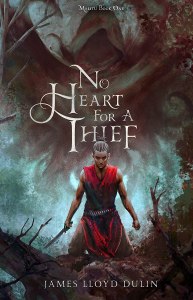
No Heart for a Thief is book 1 in the Malitu series. A story about a man who has lost everything to a war he helped start. Then he finds a girl in whom he seems himself, and reluctantly teaches her to fight in an attempt to keep her safe.
About James Lloyd Dulin
James is a nerd with a head full of stories and limited time to put them on the page.
He grew up in Grand Rapids, MI, spending an excessive amount of time at a local community theater where he developed his affinity for storytelling. This affinity grew into a deep admiration for language and spoken word poetry while studying mathematics and education at the University of Michigan. A few hundred mediocre poems and lackluster performances later, he decided his dream of writing a novel might not be as ridiculous as he once thought.
He firmly believes that art—even silly books about magic, or maybe especially silly books about magic—has the ability to tell stories that sink beneath the surface.

 Tiny Elf Arcanist
Leave a comment