My first ever guest, Cat Rector, is back with a powerful piece on the importance of libraries and the impact she can make working in one.

The other day, an older gentleman looked me in the eyes and said “The library is part of the resistance, don’t you think?” And I haven’t stopped thinking about it since.
I started working at my local Canadian library a month ago. A few days into my desk clerk training, the head librarian sat me down to discuss library policies. She explained two key things: First, patron privacy is our primary concern, which means we never share anyone’s reading activities with others. And second, the library is a neutral knowledge location where all information can be found. Among other examples, these policies mean that a questioning queer young can search for knowledge safely and privately, without being discovered by their homophobic parents.
“A large portion of the world doesn’t have access to a library.”
Access to information has always been important to me. It can open doors to new knowledge, and it’s often responsible for humanising enormous societal issues. A book, whether fiction or non-fiction, is a unique neutral space to learn without judgement or hatred.
A library can do that for people. But a large portion of the world doesn’t have access to a library. Some countries don’t have access to information at all. That’s where resistance libraries step in.
The Uncensored Library is a project that serves a handful of countries where the flow of information is restricted. It exists solely on a Minecraft server and aims to provide news and information to countries whose access is denied to them. In the words of the library itself, “[Journalist’s] forbidden articles were republished in books within Minecraft, giving readers the chance to inform themselves about the real political situation in their countries and learn the importance of press freedom.”
In places like North America, access to information can be taken for granted. I’ve watched many online discussions devolve into a stalemate of privilege as people in North America say “Just use a library!” while readers in other parts of the world scream “What libraries?!”
“Without access to knowledge, we all become more susceptible to manipulation.”
As the Uncensored Library teaches us, information is not universally accessible. It’s a privilege that some of us have and that many of us don’t. Some countries restrict available materials. In some countries, reading certain materials will get you killed. Many places lack access to audiobooks, large print books, ereaders, or other formats that make reading possible for people with disabilities. And some people simply live in the US, where books are becoming less accessible every day.
Removing people’s access to books is a deliberate act of suppression.
Providing access to books is an act of resistance.
This is deeply at odds with capitalism, however. In order to thrive under capitalism, we must pay our bills and keep the lights on, therefore information must cost money. Yet without access to knowledge, we all become more susceptible to manipulation. It’s almost like this catch-22 is part of the design.
Normally, a library is the institution that exists to bridge that gap.
If you’re lucky enough to have one.
There is no easy answer. I wish there was. For now, I can only commit to the small acts of resistance in my power. As an author, I offer free ebooks on the honour system to people who can’t access my work for any reason. Until now, it’s felt like a call to action that I couldn’t figure out how to answer.
“I can show up, do my job, and leave. Or I can show up.“
Now I have the library.
I get 15 hours a week to interact with my community, and it leaves me with a choice. I can show up, do my job, and leave. Or I can show up. I have three days a week to bring the resistance into my job. To choose diverse books for face-out displays. To welcome unhoused and poor patrons into the facilities. To meet young patrons with enthusiasm and understanding. To make sure our bathrooms are stocked to the brim with free period products. To educate people about the amazing extra things their library card gives them access to, like audiobooks and autism kits. To adorn my name tag with pride flags that say you are safe with me.
“The library is part of the resistance.”
I’m still new at this. I’m still learning about what it means to work in a library, and how I can use that job to better advocate for the people around me. This place cares about its community, and it has so much to teach me about equity, humility, and kindness. And I’m so grateful to have the opportunity to learn.
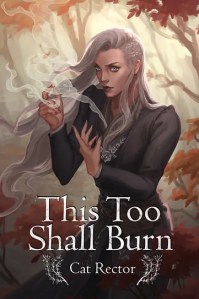
Preorder Cat’s new book This Too Shall Burn about witches, menstrual health, religion, trauma and medicine.
Also, check her interview on queer representation in her Unwritten Runes series.
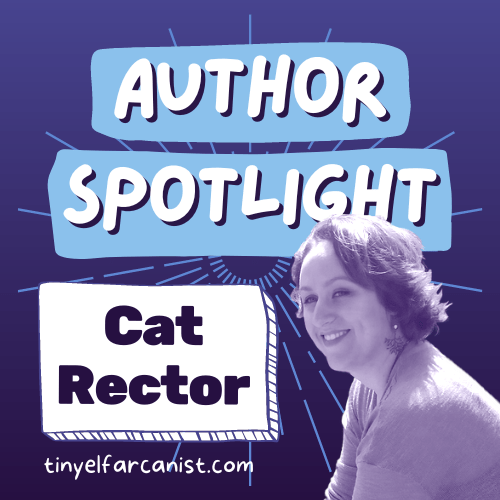
About Cat Rector

Cat Rector grew up in a small Nova Scotian town and could often be found simultaneously reading a book and fighting off muskrats while walking home from school. She devours stories in all their forms, loves messy, morally grey characters, and writes about the horrors that we inflict on each other. After spending nearly a decade living abroad, she returned to Canada with her spouse to resume her war against the muskrats. When she’s not writing, you can find her playing video games, spending time with loved ones, or staring at her To Be Read pile like it’s going to read itself.
Check Cat Rector’s website.
 Tiny Elf Arcanist
Leave a comment