
The first guest to this TEA party is everyone’s favourite cheese-hating quadruplet: C.M. Caplan. (I had to contain myself from asking “What has cheese ever done to you?” /j)

Cyborg pugs, cyborg horses, and the intricacies of C.M. Caplan’s mind. I interviewed Connor to take a look at the mind that came with these ideas and put them together to create the interesting and peculiar universe of The Fall is All There Is. You’ll want to add his book to your TBR and be on the lookout for a new collaboration with another indie author.
Interview
What is the most unexpected situation you’ve gotten inspiration from?
I want you to know I stared at this question for twenty minutes before I thought of an answer. And I think I have to go with how I invented the cyborg security pugs in The Fall Is All There Is, which came about because I was living with Sara from the Fiction Fans Podcast last summer, and she has two pugs named Mr. Squeak (who is a girl), and Snorri. And she asked if I could put them in my book somewhere. And by that point the book was almost done, and it took forever to find a place to fit them in. The answer eventually came because one of the foundational influences on the book is The Lion in Winter, which has a number of sets where stray dogs are just casually roaming around, but I knew it needed more of a sci-fi flair, and for some reason what came to mind, of all things, was a cover to… I think it was Sports Illustrated, that my brother owned when we were in middle school, that I think was accusing Bill Belichick of cheating, I think? And it had some kind of joke cover with a teddy bear that had been delivered to some rival coach with an apology note, but one eye was replaced by a camera lens. I don’t even know if I could find it again if I tried, or if my memory of it is even accurate. But those two things coalesced into stray security pugs that roam around a skeleton castle that each have one misshapen camera lens for an eye.
“I’ll focus in on the core concept: the fusion of biology and technology, and I try to figure out what kind of world would have that kind of technology.”
You get an eccentric new idea. What is the next step? How do you make it feel cohesive in your story?
A lot of the time the idea comes in waves. Like I’ll think of cyborg horses and as I write the book I slowly piece together how they work, but everything else is sort of generic high fantasy, and then slowly I realize how much I like the concept of cyborg horses, and other people seem to like it, and then in successive drafts I’ll focus in on the core concept: the fusion of biology and technology, and I try to figure out what kind of world would have that kind of technology, so I start looking for new places to add things in. So I have ships with gigantic heartbeats for engines, and veins of oil and blood. Or swords that function as lightsabers because they have a battery of human thyroid that pumps hormones into the blade that heats it up, or trains made of weird fusions of sinew and steel and fur. And then from there I have a whole eclectic mix of ideas, but I have to figure out where they even got the ability to do this. So I start inventing the old societies whose tech is getting reused, and it’s just a constant game of asking myself why is this here until eventually I feel like I have something cohesive. But then there are also a lot of ideas that wind up on the cutting room floor. A lot of it boils down to figuring out what ideas excite me, and then figuring out why it excites me, and how else I can incorporate the ethos of that idea into the book.
You said these come naturally to you. What wild concept in The Fall is All There Is are you most proud of?
Oh man I don’t even know, there are a lot of really zany ideas in that book. I think if I had to choose just one I’d pick the cyborg horses, because those have been there from the start, and they play the most important role in the plot. They were catalyst for two big moments in the middle and end of the book. Hell—the whole book started with imagery about them—the first paragraph I ever wrote in this book was one where Petre is riding up a hill on one of them. The idea of these creatures made of clockwork and steel and factory-farmed meat and sinew was the earliest version of me giving myself permission to get as wild as possible with the concepts I would allow myself to explore, and I think following the instinct is what made the book into what it is, so I’d have to go with that one, cause it all started there.
What element do you believe will be characteristic of your work? What will be assuredly present in C.M. Caplan’s future novels?
I was told a few months ago that I make very unexpected connections, both on an idea-level and on the sentence level—like I really try to put together sentences in a way that people haven’t seen before, or put two words or ideas into proximity to layer in meanings that aren’t traditionally associated. And I try to do the same thing with my worldbuilding. Seeing the world through a tilted lens is something I’ve really tried to embrace since starting this book, and writing more unexpected stuff is definitely going to inform how I go forward.
I’m planning to co-write a book with Quenby Olson in the near future, probably over the summer, involving Near Death Experiences, and the early notes I’ve made on the idea have definitely carried over the “unexpected worldbuilding” ethos that I learned on this book, because I know nobody can make bizarre dreamlike afterlife imagery the way I can, and I’m really excited to work with Quen on this, because I’ve always wanted to write romance, and Quen is possibly the single best romance writer I’ve ever read, and even down to a sentence-level, one of my favorite writers, full stop, so I’m really excited to see how that comes together.
If you would be interested in a book with thyroid-powered swords; trains of sinew, scales, and bison fur; forests of concrete and chalcedony; cyborg horses; and contagious ghosts. Oh, did I mention quadruplets’ drama on a battle for succession? Get C.M. Caplan’s latest book The Fall is All There Is.
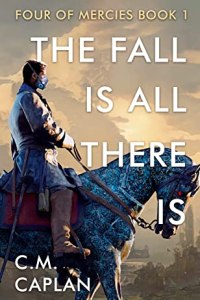
You can also read C.M. Caplan’s essay “Going All In”.
About C.M. Caplan
C.M. Caplan is the author of the SPFBO7 semi-finalist The Sword in the Street, and the post-apocalyptic science-fantasy The Fall Is All There Is. He’s a quadruplet (yes, really), autistic, and has a degree in creative writing. He was awarded his university’s highest honor in the arts for his work. His short fiction also won an Honorable Mention in the 2019 Writers of the Future Contest. If you enjoy his books, you can rate them on Goodreads and Amazon.

 Tiny Elf Arcanist
Leave a comment