Cat Rector’s debut novel, The Goddess of Nothing at All, is a dark retelling of various Norse myths told from the perspective of Loki’s wife, Sigyn, and it’s one of my favourite indie works. I can’t remember how I stumbled upon Cat’s offer for an ARC, but I didn’t think I would get one as my social reach was (and still is) nothing to brag about. She was looking for dark fantasy readers who wouldn’t reproach the presence of queer characters and I guess I was a good fit.
At the time I was on a personal journey of gender exploration. Back then, I identified as genderfluid and I found a gorgeous, complex, and powerful genderfluid character in Cat Rector’s Loki. It’s true I don’t have Loki’s shapeshifting powers, but I was elated to see part of me in such an important figure. That’s just a small example of the power of representation.
Mainstream media has a tendency to let down its queer audience. While there’s been a recent rush of queer productions, they’re not always accurate and queerness is sometimes tokenized. Even most contemporary media still lacks the diversity contained in life.
History has also suffered from queer erasure. True to most mythology, the Unwritten Runes duology is full of queer characters. They are Rector’s own interpretations due to lost information on Norse mythology. Keep reading to learn about the queer representation in these books from the author herself.
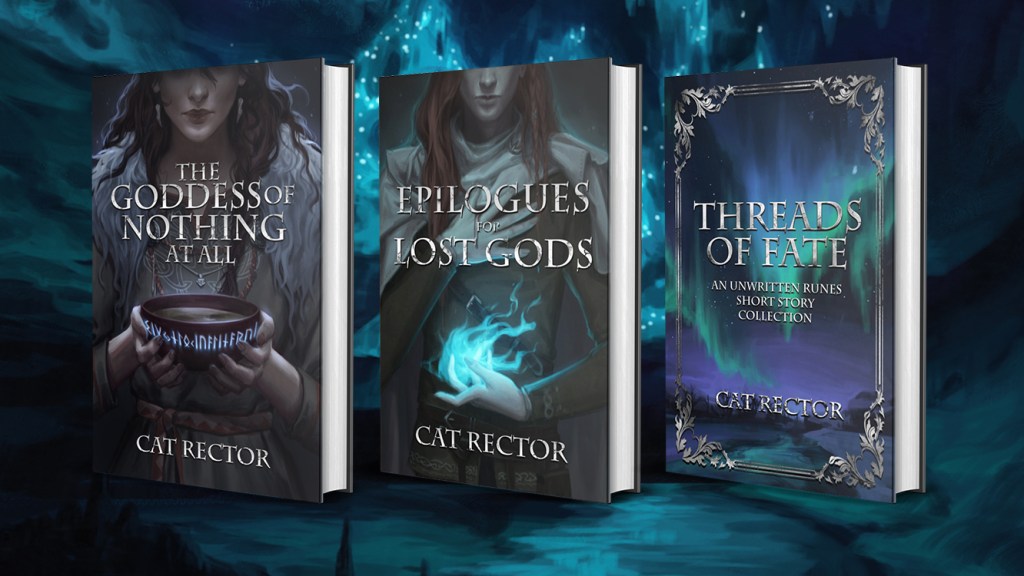
Click the image to check them out.
Interview
I know characters can sometimes take life on their own. Was your rendition of Sigyn originally conceived as bisexual or is it something you discovered along the way?
Sigyn was the character that took the longest to build. Many of her traits were built around Loki. Sigyn was supposed to be the order to Loki’s chaos. I wanted her to be a strong opposing force that would balance him out. When it came to her sexuality, however, that was different.
I knew from minute one that Loki was a queer character, and I wanted him to have a spouse who understood and appreciated that in him. In my own logic, his wife would absolutely have to be queer, but I wasn’t sure in what specific way.
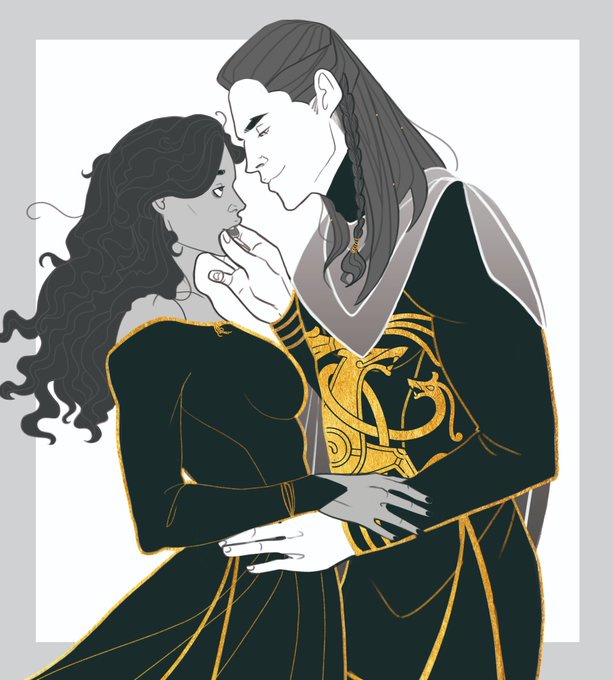
Art by Lilithsaur
In my version of things, Loki is pansexual and genderfluid. In a perfect match, he’d be with someone that appreciates all the renditions of his shapeshifting, genderfluid self. I think in a practical, plot-driven sense, it made sense for her to be at least bi or pan, so that she would instinctually value that part of her spouse. From a more emotional standpoint, I now realize that I was drawn to writing Sigyn as bisexual because I was bisexual too, something I’d been shoving down for most of my life. Two years into the process, I kind of sat up one day and went oooohhhhh. This all makes much more sense now.
Sigyn is special to me in a lot of ways. There are traits of hers that embody important things in my life and the lives of people I love. A lot of my characters have sprinkles of my traits and experiences in them, for better or worse. But this time…well, it was a surprise even to me!
Narvi is different from the usual character archetype I prefer, but he won my heart in GoNaa. What was your experience writing an ace character, an underrepresented queer identity?
I love that people are attached to Narvi. Among other things, he’s one of the sole characters that’s inherently good and deserves oodles of love.
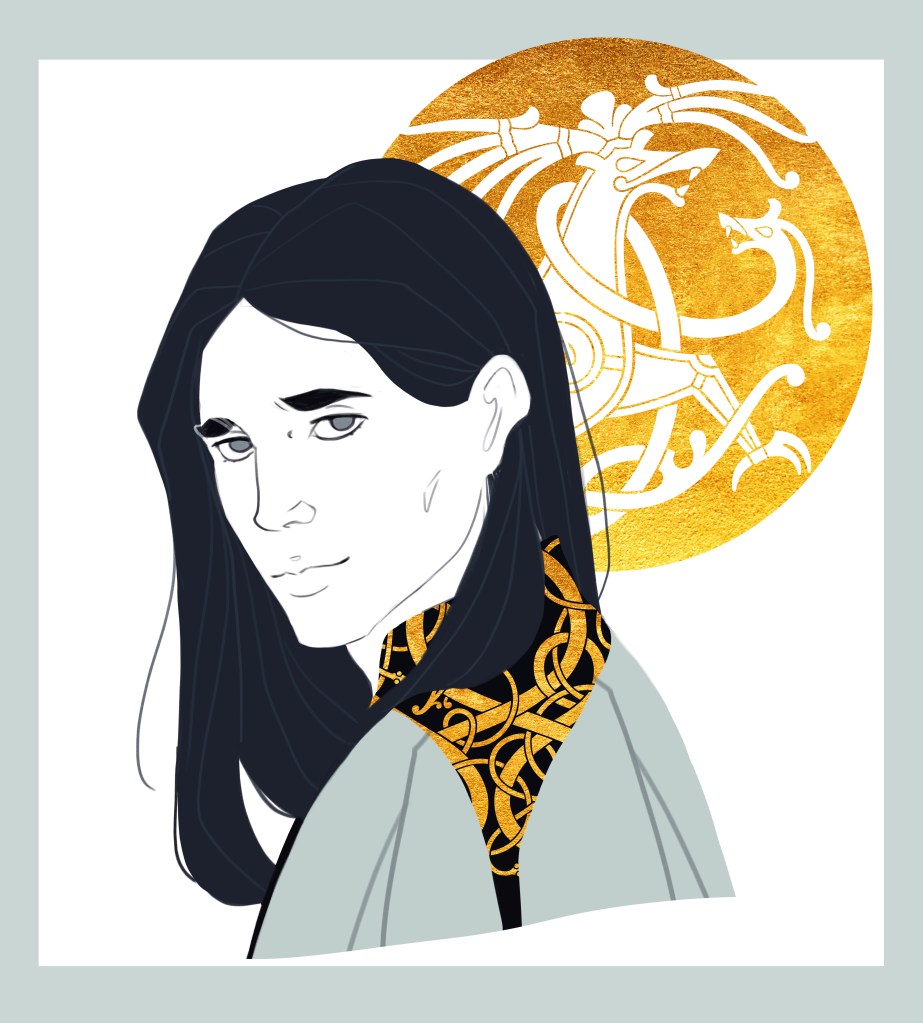
Art by Lilithsaur
From a design standpoint, I wanted Narvi to be the opposite of his brother, Váli. He would be soft and gentle, and peaceful to the point of naivete. He’s also comfortable in his skin, knows who he is, and his convictions in nonviolence are strong.
I knew Narvi was ace without him really telling me. There was this general sense of no thank you when it came to his attraction to other people. He was content as he was and had no real interest in relationships, and certainly not in any sexual component of them.
In some senses, his character traits have to do with his being ace, and in some senses, they don’t. Narvi is an intense bookworm and a study bug in part because he just is. It also serves him very well that his hormones didn’t turn him into a little teenage horndog, because he can have that laser focus that he thrives in when it comes to his interests and his platonic loved ones. He has plenty of love to go around, but his priorities have never included chasing tail.
What literary work would you like to rewrite that you believe would greatly benefit from a queer retelling?
Oh, so many. I’m not the biggest reader of older literature, but many books could use a modern queer retelling.
One of the staple parts of my childhood was The Lord of the Rings. My father was obsessed with Tolkien and the animated movies were playing consistently. I love them in a way I can’t explain. And the series also lacks the richness of diversity.
Which is ironic since it’s a story about different types of beings banding together to overcome the dark lord Sauron.
Most of the adult men I grew up around thought it was too gay to sing out loud.
If you came to me tomorrow and said “Cat we did it. We upgraded The Lord of the Rings” I’d be so happy. Fandom has been picking up the queer-coded moments or characters for a long time, so there’s plenty of existing material hinting in that direction. There’s even an entire essay someone wrote about Frodo and Sam, and how there’s evidence for them being lovers based on Tolkien’s writing. And don’t get me started on elves. Elves are singers, artists, poets, and warriors of immense grace. Knowing the kind of world Tolkien lived in, I think it’s important to recognize how much beauty and softness he built into the elves. Most of the adult men I grew up around thought it was too gay to sing out loud, and yet Legolas sings in these books. I could go on at length as to what I think that means in relation to gender roles and sexuality, but suffice it to say, I think Tolkien was already hinting at a few things.
I’m never going to write a book like this. I’m not the right person for the job. I’m deeply glad that fantasy writers have been creating Tolkien-sized worlds with diverse, queer casts. I think we deserve to see ourselves in these worlds.
I heard you were working on a new project with queer themes. Is there a queer identity in it you enjoyed exploring?
My newest project is aptly titled Witch WIP while I hunt for a proper name. It’s a Puritan Witch Hunt-inspired dark fantasy that explores the history of medicine and its link to witchcraft, while also incorporating themes of religious trauma and menstrual health. Our witchy main character is pansexual and expresses that openly and fervently throughout the book. Our villager MC doesn’t have a romantic or sexual plotline, and hasn’t really told me yet where she stands on things.
Sometimes it’s nice to have queer-friendly societies in books.
The thing I’m enjoying exploring this time is queerness in the culture. For this book, I’ve constructed a Christian-like fantasy religion. While creating the religion, I decided I wanted it to have no obvious issues with queer people, because sometimes it’s nice to have queer-friendly societies in books. It proves to be a challenge, however, because so much of gender, sexuality, and societal norms are tangled up in each other. For example, I need certain aspects of gender roles to remain in order to tackle them in the story. At the same time, I want characters to be allowed to step into gender roles they weren’t born into, and to be free to live within the gender expression they choose. It’s hard! I think I’m getting somewhere, though. I’m excited to take my version of things to a team of queer beta readers in order to strengthen my concepts.
It’s both intimidating and exciting to play with something like this. As an author, worldbuilding can be great fun, especially when we get to imagine a better world for ourselves and our communities. At the same time, there’s a lot of risk. I’m playing with something that has a very real effect on people in the real world. I’m always walking the tightrope of attempting to do something interesting and challenging, while also acting with respect, knowledge, and good intention. Part of that means learning to live with the risk. There’s a good chance that someone will disagree with what I’ve done, no matter how careful I am. Luckily for myself, I’ve had excellent readers who take me in good faith and have helped me create thoughtful commentary instead of careless harm.
Books in the Unwritten Runes duology
The Goddess of Nothing At All

Dark Norse mythology retelling of Sigyn, Loki’s wife. It’s gut-wrenching, so get ready for the ride.
Epilogues of Lost Gods

As Cat puts it, this book “explores the emotional fallout of Book 1.” The final chapter in the series.
Threads of Fate
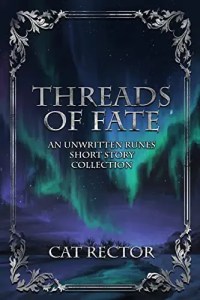
Collection of short stories delving into the lives of characters in the Unwritten Runes.
Pre-order Epilogues for Lost Gods.
About Cat Rector

Cat Rector grew up in a small Nova Scotian town and could often be found simultaneously reading a book and fighting off muskrats while walking home from school. She devours stories in all their forms, loves messy, morally grey characters, and writes about the horrors that we inflict on each other. After spending nearly a decade living abroad, she returned to Canada with her spouse to resume her war against the muskrats. When she’s not writing, you can find her playing video games, spending time with loved ones, or staring at her To Be Read pile like it’s going to read itself.
 Tiny Elf Arcanist
Leave a comment